AEO vs GEO vs SEO: The 2026 Answer Engine Strategy Guide
How SEO, AEO, and GEO fit together, and how to optimize once and win everywhere.
The acronyms are multiplying and it is causing confusion. SEO, AEO, GEO. Marketers keep asking which one replaces which. The honest answer is that they are not rivals. They are three layers of the same visibility stack, each targeting a different surface, and the smart play in 2026 is to build them together rather than betting on one.
Here is what each layer actually does, the tactics that matter, and how to sequence the work so a single effort pays off across all three.
The three layers, defined
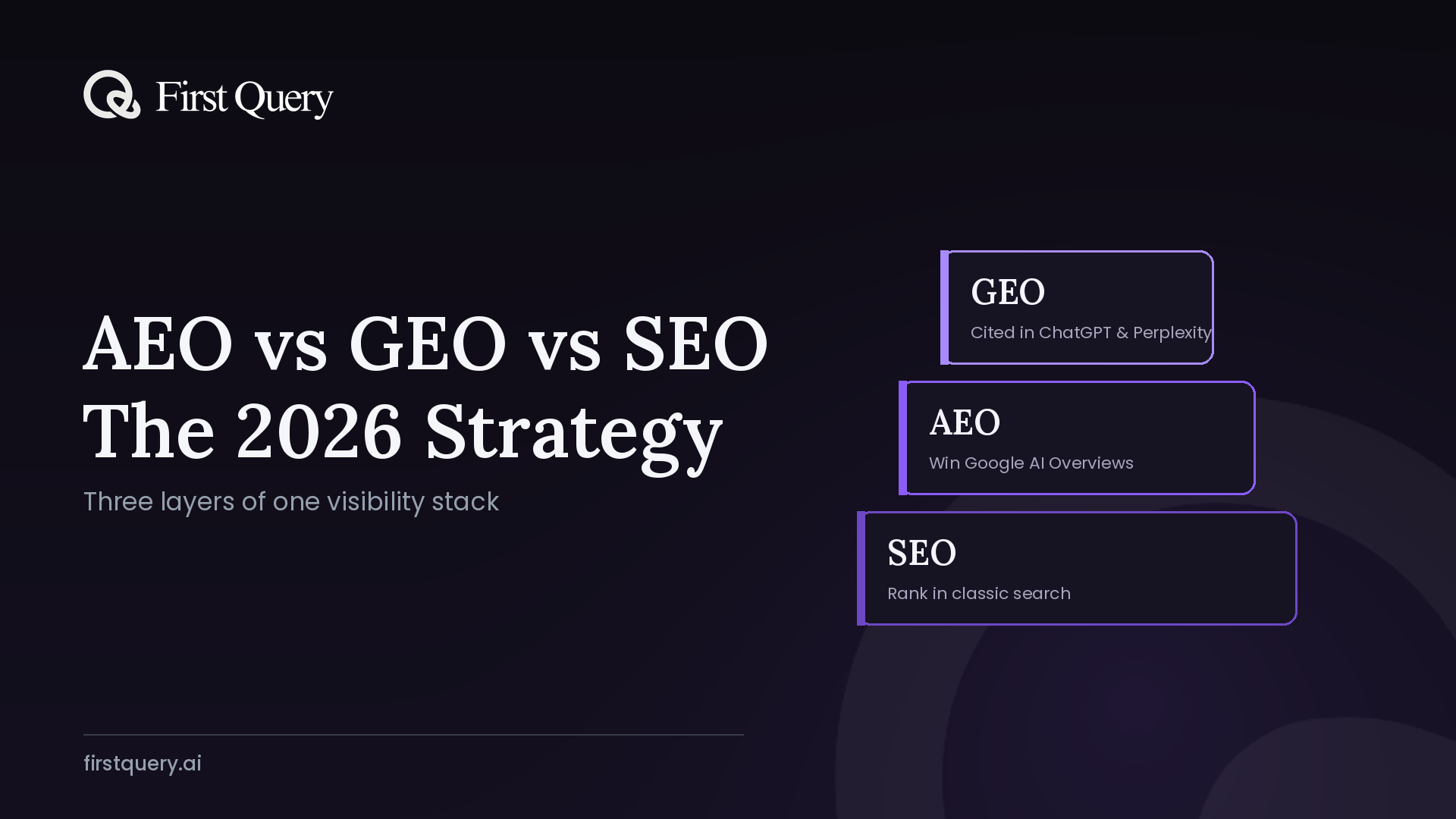
The simplest way to hold it in your head: SEO gets you ranked, AEO wins you the answer on Google, and GEO gets you cited inside the AI assistants people now ask directly.
How tightly they connect
This is the nuance most guides miss. AEO and GEO do not behave the same way relative to your existing SEO. For Google's AI Overviews, your classic ranking matters a lot. Studies have found roughly a 92% correlation between pages ranking in the organic top 10 and pages cited in AI Overviews. If you are not on page one, the answer engine is unlikely to read you.
Generative engines are different. ChatGPT and similar tools pull from a broader, messier set of sources, and your Google rank is a much weaker predictor of whether they cite you. That is why a brand can be absent from Google's first page and still get named by ChatGPT, and why GEO needs its own playbook rather than riding on SEO alone.
The tactics, side by side
The good news is how much the work overlaps. Optimize the fundamentals well and you move all three layers at once.
| Layer | Core tactics | Typical time to results |
|---|---|---|
| SEO | Technical health, quality content, internal links, backlinks, crawlability | 3 to 6 months |
| AEO | Question-and-answer formatting, 40-60 word direct answers, FAQ and HowTo schema | 30 to 60 days |
| GEO | Extractable structure, entity consistency, expert sourcing, third-party citations | 6 to 12 months |
AEO tends to move first because Google re-crawls and re-indexes on a fast cycle. GEO takes longer because generative models retrain and rebuild confidence on their own schedules. Plan accordingly and do not judge GEO on a 30-day timeline.
What the research says actually works
The most cited study here is the Princeton GEO research, which tested what changes a brand's visibility inside generative answers. The findings are practical and repeatable.
The pattern is clear. Quotes, statistics, and credible references are not decoration. They are the raw material generative engines look for when deciding whom to trust and cite.
How to sequence the work
- Get the SEO foundation right. Without crawlable, quality pages, the answer engines have nothing solid to read.
- Layer AEO on your priority pages. Add question-led structure, concise direct answers, and schema for fast wins in Google AI Overviews.
- Build GEO on top. Strengthen entity consistency, expert sourcing, and third-party citations to earn generative recommendations over time.
- Measure each surface separately. Rankings for SEO, answer presence for AEO, citation share for GEO.
Frequently asked questions
Does GEO replace SEO?
No. SEO is the foundation. AEO and GEO add visibility in answer engines and generative tools, but they build on solid search fundamentals rather than replacing them.
What is the difference between AEO and GEO?
AEO targets direct answers on Google, such as AI Overviews and featured snippets, and leans on your Google ranking. GEO targets citations inside generative engines like ChatGPT and Perplexity, which pull from a broader set of sources.
Which should I prioritize?
Fix SEO foundations, then add AEO for quick answer-surface wins, then invest in GEO for durable generative recommendations. The work overlaps, so you rarely choose just one.
Why does GEO take longer than AEO?
Google re-indexes quickly, so AEO changes can show in weeks. Generative models retrain on slower cycles, so GEO results typically build over several months.
First Query helps brands build all three layers as one program, so a single effort compounds across search rankings, AI Overviews, and generative answers. Learn more at firstquery.ai.